
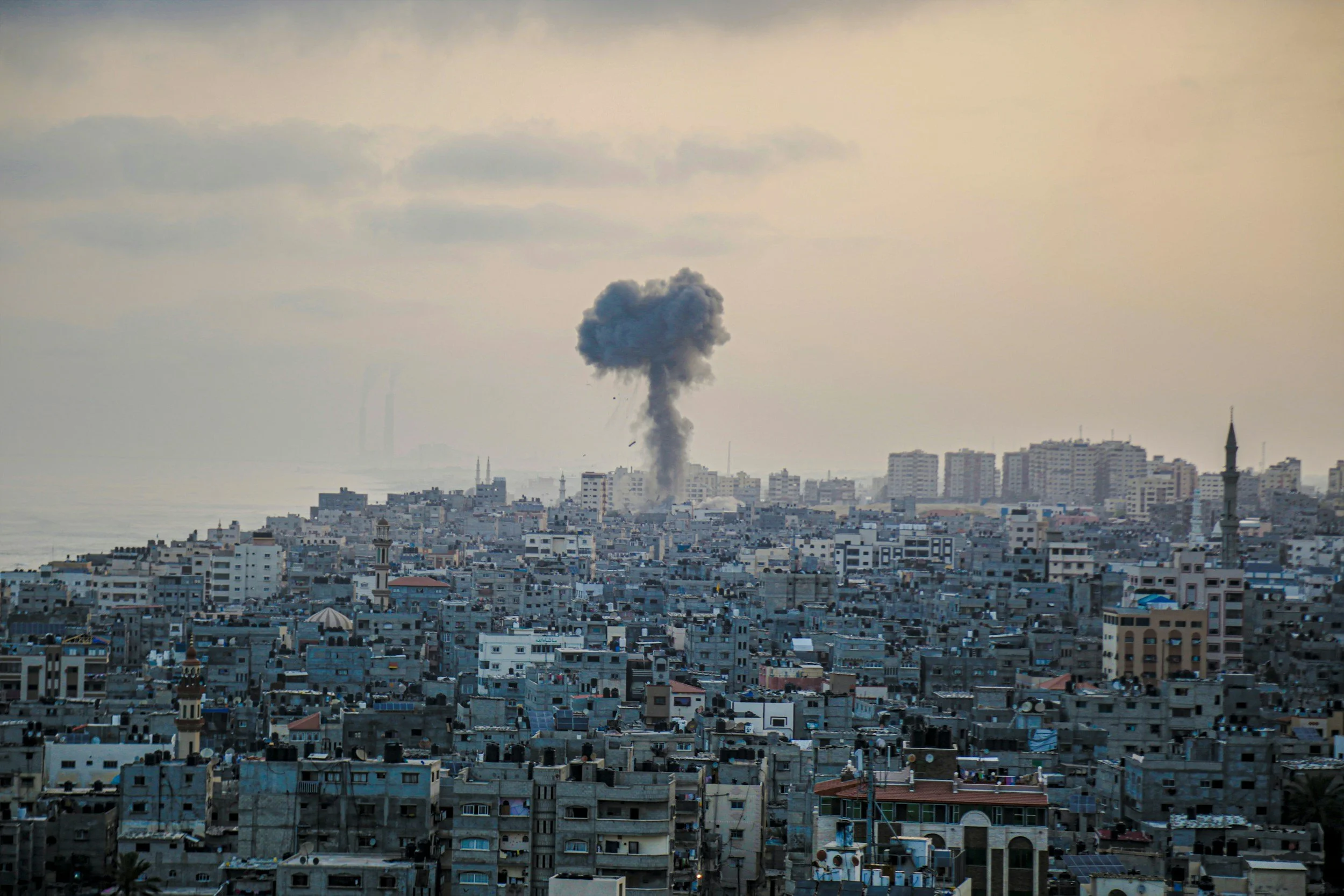
The PRCP, in collaboration with the IPSOS polling agency, conducted a four-wave study tracking how Czech attitudes towards Israel and the Israeli-Palestinian conflict have evolved from 2022 to 2026. The results from a representative sample of the Czech adult population show that neutrality or the absence of a clear opinion remains the dominant stance among the Czech public. Since 2024, however, the proportion of positive perceptions of Israel has been visibly declining, while the proportion of negative perceptions has been rising. This shift is most pronounced among women aged 18–29, where nearly half of the female respondents expressed a negative attitude toward Israel in 2026.
main findings
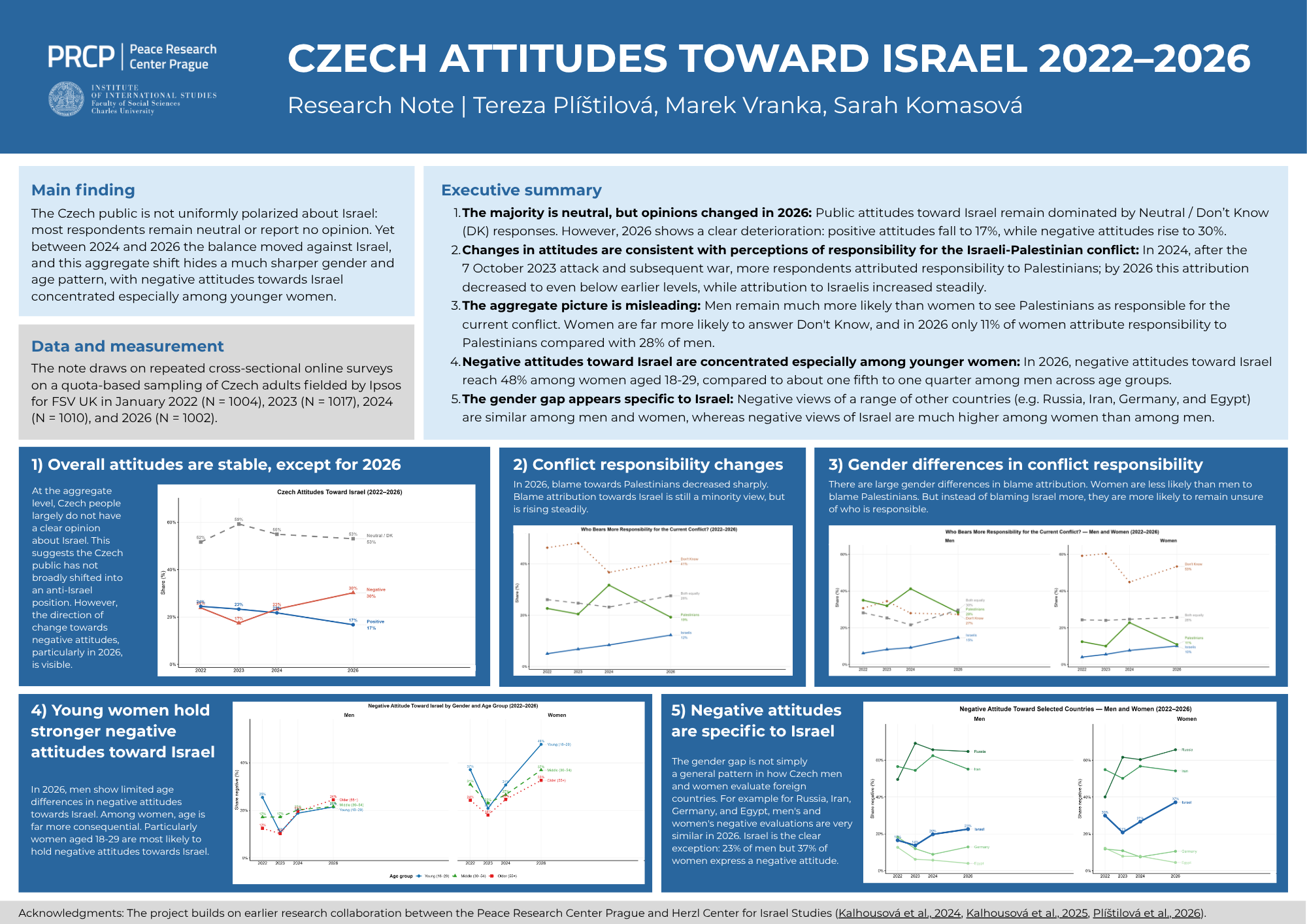
Across the whole public, attitudes toward Israel remain dominated by Neutral / Don’t Know responses. However, 2026 shows a clear deterioration: positive attitudes fall to 17%, while negative attitudes rise to 30%.
The timing and direction of this shift are consistent with changing perceptions of responsibility for the ongoing Israeli-Palestinian conflict. In 2024, after the 7 October 2023 attack and subsequent war, more respondents attributed responsibility to Palestinians; by 2026 this attribution had fallen back and even below earlier levels, while attribution to Israelis continued to increase steadily.
The aggregate picture is misleading. Men remain much more likely than women to see Palestinians as responsible for the current conflict. Women are far more likely to answer Don't Know, and in 2026 only 11% of women attribute responsibility to Palestinians compared with 28% of men.
Gender differences in attitudes toward Israel are large and concentrated especially among younger women. In 2026, negative attitudes toward Israel reach 48% among women aged 18-29, compared with about one fifth to one quarter among men across age groups.
The gender gap appears specific to Israel in the comparison set. Negative views of Russia, Iran, Germany, and Egypt are similar among men and women, whereas negative views of Israel are much higher among women than among men.
data and measurement details
In January 2022, 2023, 2024, and 2026, we fielded an online survey on four quota-representative samples (gender, age, education, region, and municipality size) of the adult Czech population (each target N = 1000) through the polling company IPSOS. We then applied weights to (self-reported) voting in the Parliamentary elections (2021 and 2025).
The survey includes a wide range of questions designed to capture attitudes towards Israel and views on the Israeli-Palestinian conflict. In the research note, we present results on the following questions:
'attitude' (Q1): What is your attitude towards the following countries? measured on a 5-point Likert scale ranging from Very positive (1), through Somewhat positive (2), Neutral (3), Somewhat negative (4), to Definitely negative (5), and I don't know, cannot say (99). Israel is one of the presented countries.
'current responsibility' (Q12): Who do you think currently has a greater share in the continuation of the Israeli-Palestinian conflict? measured on a 5-point Likert scale ranging from Definitely Palestinians (1), through Rather Palestinians (2), Both nations equally (3), Rather Israelis (4), to Definitely Israelis (5), and I don't know, cannot say (99).
Acknowledgments
The project builds on earlier research collaboration between the Peace Research Center Prague and Herzl Center for Israel Studies (Kalhousová et al., 2024, Kalhousová et al., 2025, Plíštilová et al., 2026):
Kalhousová, I., Plíštilová, T., Komasová, S., Smetana, M., & Vranka, M. (2024). Češi a Izrael 2023–2024. Pozice české veřejnosti a českých politických elit. Special Research Report. https://www.prcprague.cz/s/ei-a-Izrael-20232024.pdf
Kalhousová, I., Komasová, S., Plíštilová, T., Smetana, M., & Vranka, M. (2025). Elite-public gaps in attitudes towards Israel and the Israeli-Palestinian conflict: new evidence from a survey of Czech parliamentarians and citizens. East European Politics, 41(1), 142-158. https://doi.org/10.1080/21599165.2024.2415641
Plistilova, T., Komasova, S., & Vranka, M. A. (2026, February 28). Impact of the Gaza War on Attitudes towards Israel [Preprint]. https://doi.org/10.17605/OSF.IO/UB9MN